
What is a passkey wallet
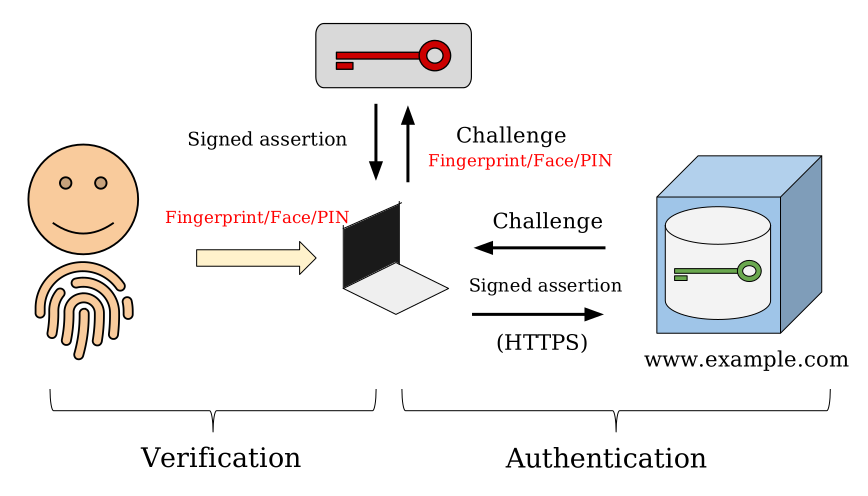
A passkey wallet is a self-custodial crypto account that replaces traditional mnemonic seed phrases with biometric authentication. Instead of writing down twelve or twenty-four words, the wallet uses your device’s built-in security—such as Face ID, Touch ID, or a PIN—to sign transactions. This technology leverages the WebAuthn and FIDO2 standards, the same protocols that secure your banking apps and email accounts, to create a more intuitive and secure entry point into Web3.
At its core, a passkey wallet is a smart contract account. While the private keys still exist, they are generated and stored within the Secure Enclave of your smartphone or computer. When you need to approve a transaction, your device verifies your identity biometrically and signs the data locally. The signed transaction is then broadcast to the blockchain. This process eliminates the risk of phishing attacks targeting your seed phrase and removes the friction of manual key entry.
To understand how this differs from traditional setups, consider the distinction between standard accounts and those enhanced with passkeys:
The shift toward passkey wallets is driven by the need for better user experience without compromising security. By integrating with account abstraction, these wallets can offer features like social recovery and gas sponsorship, making crypto interactions feel as simple as unlocking a phone. For a visual context on the market movement driving this adoption, see the current ETH/USDC chart below.
How passkeys replace seed phrases
The shift from seed phrases to passkeys marks a fundamental change in how private keys are managed. Traditional non-custodial wallets store a 12- or 24-word mnemonic phrase that users must memorize or write down. If that phrase is lost, the assets are gone forever. If it is stolen, the wallet is compromised. Passkey wallets remove this burden by binding the private key to the device's secure enclave, using biometrics like Face ID or Touch ID as the authentication gate.
This system relies on the WebAuthn standard, which generates a public-private key pair where the private key never leaves the device. Instead of a single seed phrase, the wallet uses a P-256 key stored in tamper-resistant hardware. Every transaction requires the user to authenticate via their device’s biometric sensor or PIN, ensuring that only the device owner can sign transactions. This approach aligns with the ERC-4337 account abstraction standard, allowing smart contracts to manage authentication logic without exposing the underlying key material.
The following table compares the operational differences between traditional seed-based wallets and modern passkey implementations:
| Feature | Seed Phrase Wallet | Passkey Wallet |
|---|---|---|
| Key Storage | User-held mnemonic text | Device secure enclave |
| Authentication | Phrase entry + password | Biometrics or device PIN |
| Recovery | Mnemonic backup | Device replacement or social recovery |
| Phishing Risk | High (phrase can be stolen) | Low (key never leaves device) |
This architecture eliminates the need for users to manage complex cryptographic backups while maintaining self-custody. The private key remains on the device, but the user experience shifts from memorizing words to authenticating with familiar biometric methods. This reduces the friction of onboarding and the risk of catastrophic loss due to misplaced notes or screenshots.
To understand the market context for this technological shift, we can look at the performance of major assets that benefit from improved wallet usability. The following chart shows the recent price action of Ethereum, the primary network driving ERC-4337 adoption.
Phishing Resistance and Hardware Security
Traditional wallets rely on seed phrases or password-based logins that are vulnerable to social engineering and phishing attacks. Passkey wallets change this dynamic by leveraging the FIDO2/WebAuthn standards, which cryptographically bind authentication to a specific domain. This means a passkey cannot be harvested by a fake login page because the cryptographic proof is only valid for the legitimate application URL.
Beyond domain binding, passkey wallets utilize hardware-level security. The private keys are stored in the Secure Enclave of your device, such as the Trusted Execution Environment (TEE) on mobile devices or the TPM on computers. This ensures that even if your device is compromised by malware, the cryptographic keys cannot be extracted or used without your biometric consent (Face ID, Touch ID, or Windows Hello).
| Feature | Traditional Wallet | Passkey Wallet |
|---|---|---|
| Authentication | Seed phrase or password | Biometric or hardware key |
| Phishing Vulnerability | High (credentials can be stolen) | Low (domain-bound) |
| Key Storage | Software or paper | Hardware Secure Enclave |
| Recovery | Complex seed phrase backup | Account abstraction or device sync |
This hardware-backed approach aligns with the security standards used by major financial institutions and government entities. By moving away from shared secrets (passwords) to public-key cryptography anchored in hardware, passkey wallets significantly reduce the attack surface for common crypto threats.
ERC-4337 and account abstraction
Passkey wallets do not exist in isolation; they rely on ERC-4337, the Account Abstraction standard, to function. Before this standard, Ethereum accounts were simple key pairs. ERC-4337 introduced smart contract accounts, allowing developers to customize how transactions are validated and executed.
This infrastructure shift is what makes biometric authentication possible. Instead of storing a private key on a device, the passkey wallet stores a smart contract on-chain. The passkey acts as the signer, validating transactions through the ERC-4337 mempool before they are included in a block.
The market context for this infrastructure is clear. Ethereum continues to serve as the primary settlement layer for these advanced account structures.
To understand the architectural change, compare traditional wallets with account abstraction models:
| Feature | Traditional Wallet | ERC-4337 Wallet |
|---|---|---|
| Authentication | Private Key File | Passkey / Biometric |
| Recovery | Seed Phrase | Social / Passkey Backup |
| Transaction Logic | Fixed (EIP-1559) | Customizable Smart Contract |
The Passkeys Foundation and GitHub repositories like passkeys-4337/smart-wallet provide the technical specifications for this implementation. By decoupling the key from the account, ERC-4337 enables a user experience that matches Web2 security without sacrificing self-custody.
Market adoption and provider landscape
The shift toward passwordless authentication in 2026 is moving from experimental to standard. Major providers are embedding passkey wallets directly into Web3 smart accounts, replacing traditional seed phrases with biometric authentication methods like FaceID or TouchID. This transition simplifies onboarding and improves security by leveraging WebAuthn and account abstraction standards.
To understand the current market state, it helps to compare the underlying mechanics of traditional seed phrase wallets against the newer passkey-based models. The following table highlights the primary differences in security architecture, recovery processes, and user experience.
| Feature | Passkey Wallet | Seed Phrase Wallet |
|---|---|---|
| Authentication | Biometric (FaceID, TouchID, PIN) | Manual 12-24 word entry |
| Recovery | Device-based or social recovery | Secret recovery phrase |
| Security Model | Hardware-backed secure enclave | User-managed private key |
| Onboarding | Instant, familiar login flow | Manual backup and verification |
The adoption curve is closely tied to market liquidity and user trust. As institutional players integrate passkey standards, the volume of transactions on compatible chains often correlates with broader crypto market trends. The following chart illustrates the recent performance of Ethereum, which serves as the primary settlement layer for many of these emerging passkey-enabled smart accounts.
What happens if you lose your device?
The biggest fear with any crypto wallet is losing access to your funds. Traditional seed phrases solve this by letting you restore your wallet on any device, but passkey wallets work differently. Because your private key never leaves the secure element of your phone, you cannot simply write down a list of words and memorize it. If your phone is lost or stolen, you do not automatically lose your funds, but you do need a recovery plan.
Most passkey wallets are built on smart accounts, which means they use account abstraction to add social recovery. Instead of relying on a single piece of hardware, you designate trusted contacts—like family members or close friends—who can help verify your identity and restore access if you lose your primary device. This shifts security from "who has the paper" to "who do you trust." You can also often back up your passkey to your iCloud or Google account, allowing you to restore your biometric credentials on a new phone.
It is important to understand that passkeys are not magic. They introduce a new set of risks, primarily centered around device dependency and account takeover. If your trusted contacts are inactive or if your cloud backup is compromised, recovery can be difficult. This is why setting up social recovery before you lose your device is critical.
To see how these wallets compare to traditional setups, consider the trade-offs:
| Feature | Passkey Wallet | Traditional Wallet |
|---|---|---|
| Recovery Method | Trusted contacts or cloud backup | Written seed phrase |
| Device Loss | Recover via trusted contacts | Restore with seed phrase |
| Phishing Risk | Low (origin-bound) | High (user must verify URLs) |
The market context for these wallets is tied to the broader adoption of Ethereum and stablecoins. As more users move away from custodial exchanges, the need for self-custody solutions that don't require technical expertise grows. The price of ETH and USDC serves as a baseline for the value being protected.
Before you rely on a passkey wallet, ensure you have followed these security steps:
-
Enable social recovery and add at least three trusted contacts
-
Test the recovery process with a small amount of funds
-
Back up your cloud credentials (iCloud/Google) securely
If you are managing significant assets, consider diversifying your storage. A passkey wallet is excellent for daily transactions, but keeping a portion of your funds in a cold storage solution with a seed phrase can provide an additional layer of safety against device-specific failures.
Frequently asked: what to check next
What is a passkey wallet?
A passkey wallet is a Web3 smart account that replaces traditional seed phrases with biometric authentication methods like FaceID or TouchID. By using WebAuthn and account abstraction, these wallets simplify onboarding and improve security Passkeys Foundation.
How do I access a passkey?
Access requires a compatible device with a secure enclave (like a smartphone or laptop). When you log in, your device verifies your identity via biometrics or a PIN, then signs the transaction cryptographically without exposing the private key to the app.
What are the risks of passkeys?
The primary risk is device dependency. If you lose your phone or it breaks, recovering access can be difficult without a pre-configured recovery plan. Additionally, if your device is compromised by malware, the biometric prompt may be spoofed, though hardware-level isolation mitigates this.
How to find passkey for Base wallet?
To find your passkey on Base, you must use a compatible wallet app like OKX or MetaMask that supports passkey integration. There is no standalone "passkey file" to find; the key lives securely in your device's hardware enclave. You access it simply by opening the app and authenticating with your face or fingerprint.
No comments yet. Be the first to share your thoughts!